Last updated: May 2026
If your supervisor says JHA, your client form says JSA, and your crew just wants to start work, the naming debate burns time you do not have. We see this on active contractor sites all the time. JHA vs JSA is usually a terminology difference for the same task-level hazard analysis process. The work that keeps people safe is not the label. It is whether hazards, controls, briefings, and sign-offs are done properly before work starts.
⚡ Quick Answer
- Are they different?: In most workplaces, JHA and JSA mean the same method with different naming conventions.
- Canada evidence: CCOHS states JSA is also referred to as JHA (revised 2024-01-04).
- US evidence: OSHA guidance references job hazard analyses, also known as job safety analyses.
- Best practice: Standardize one company template and one trigger matrix instead of debating terms.
- Scope check: CCOHS says most jobs can be described in fewer than 10 steps.
JHA vs JSA in One Sentence
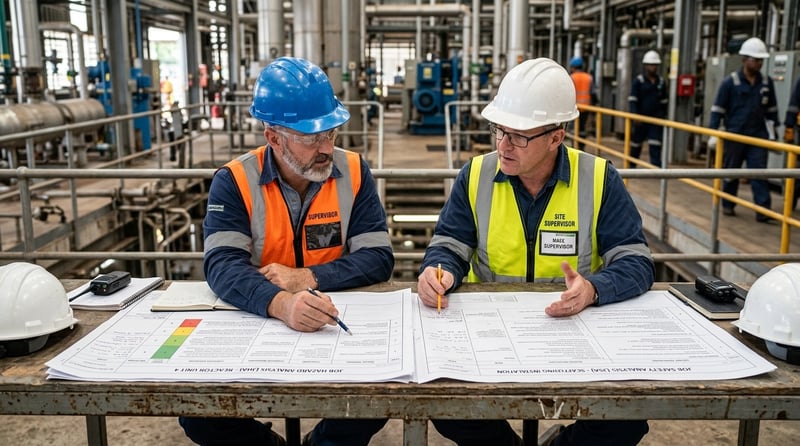
In practice, JHA and JSA are usually interchangeable names for the same pre-task hazard analysis workflow. On one site, a prime contractor may call it a JSA. On another site, the same process is called a JHA. The core method does not change: break the task into steps, identify hazards for each step, define controls, and brief the crew before work begins.
Most people think picking the “right” label is the hard part. They are wrong. The hard part is consistency across supervisors, crews, and documentation. If one foreman uses a 2-page JSA, another uses a 1-page JHA, and a third runs only verbal checks, you have process drift that shows up during incidents, client audits, and prequalification reviews.
The blunt truth is this: companies do not fail audits because they chose JHA or JSA. They fail because there is no evidence trail that controls were selected, communicated, and followed in the field. If you need a baseline, align your team around one internal format, train to that format, and only rename the header when a client or contract requires it.
What Changes in Practice, and What Does Not
What stays the same between JHA and JSA is what actually matters for risk reduction. CCOHS describes a structured process that includes selecting the job, breaking it into steps, identifying hazards, and determining preventive measures. OSHA guidance similarly refers to job hazard analyses, also known as job safety analyses, inside hazard identification programs.
- Same objective: Identify hazards before exposure and reduce risk before work starts.
- Same workflow: Task steps, hazards, controls, communication, sign-off.
- Same quality bar: Site-specific hazards, practical controls, clear responsibilities.
- Different in admin only: Form title, template branding, and prequalification wording.
- Different by client: Some bid packages demand a specific term in submitted records.
That means your operations playbook should treat JHA/JSA as one method with configurable labels. If your internal form is standardized, you can map that same content to client-facing naming requirements without retraining everyone each time a project changes owners.
CCOHS Job Safety Analysis guidance and OSHA hazard identification guidance both support this practical interpretation. Focus on method integrity, not acronym loyalty.
Decision Framework, Which Term Should You Use on This Job
Use this order of operations on every new project. First, comply with legal duties and jurisdiction language. Second, comply with explicit client contract requirements. Third, apply your internal standard. This keeps your process defensible without forcing teams to relearn core risk analysis each time they change sites.
| Decision factor |
What to check |
Output decision |
| Jurisdiction and legal framing |
Regulator guidance and hazard assessment duties |
Use compliant language in official records |
| Client or prime contractor contract |
Bid docs, onboarding packs, permit packages |
Mirror required term on submitted forms |
| Company standard |
Your approved template, workflow, and training |
Keep one internal process and naming map |
| Task risk profile |
Heights, confined space, energized work, lifting/rigging |
Require fresh analysis before shift start |
| Documentation destination |
Permit package, daily file, audit evidence repository |
Ensure term matches downstream system requirements |
Messy real-world example: a 38-person mechanical contractor working a shutdown had three document streams in one week, client JSA form, internal JHA template, and an FLHA card at the workface. Nothing was technically missing, but terminology mismatch caused duplicate paperwork and missed sign-offs on a hot-work permit handoff. The fix was simple. Keep one master workflow, then auto-label outputs by destination form.
Your crews should not use three forms for one hazard analysis process
If JHA and JSA naming changes are creating rework, run one standardized digital workflow and adapt labels by client requirement.
Start Your 30-Day Free Trial →
Canada vs US, Keep Legal Duties Clear Without Mixing Rules
In Canada
Canadian guidance often uses Job Safety Analysis language and explicitly recognizes Job Hazard Analysis as an alternate term. CCOHS states this directly and provides the same core method: break the task into steps, identify hazards, and determine controls. It also notes most jobs can be described in fewer than 10 steps, which is a useful quality check against overbuilt forms.
Across provinces, legal obligations are generally framed around hazard assessment and control duties, not enforcing one exact acronym. If your contract says JSA but your internal team says JHA, your risk is usually not the word choice. Your risk is incomplete hazard controls or weak proof that the crew was briefed before work.
In the US
US federal OSHA guidance on hazard identification references both terms, including the phrase job hazard analyses, also known as job safety analyses. In practice, OSHA enforcement focuses on whether hazards were identified and controlled, supported by training and safe work execution, not whether your form header says JHA or JSA.
For high-risk tasks, align your terminology with the contract package and keep your evidence package clean. If training or PPE obligations apply under standards like 29 CFR 1910.132 or 29 CFR 1926.503, your documentation should clearly connect hazard assessment decisions to field controls.
From Analysis to Field Execution, FLHA, Permits, Toolbox Talks, and Sign-Off
A strong JHA/JSA is not a standalone PDF. It is the start of the execution chain. The sequence should be predictable on every shift so supervisors and crews know exactly what happens next and where proof is stored.
- Pre-task analysis: Break the task into steps and identify hazards by step.
- Controls selected: Apply controls in practical order, with clear ownership.
- Crew alignment: Tie controls into FLHA cards and toolbox talk briefing points.
- Permit tie-in: Attach relevant controls to permits, for example confined space, hot work, isolation.
- Sign-off and archive: Supervisor and workers confirm understanding, then records are stored for audit traceability.
If your team still runs this on paper, keep version control explicit. Stamp revision date, review trigger, and approving role on every template. If you are moving digital, create digital JHA/JSA and FLHA forms in the field so supervisors are not chasing missing pages after shift change.
For program-level standardization, build and standardize your safety program with done-for-you support. For field training support, teams often pair this process with the Ultimate Guide to Toolbox Talks and keep the Incident Report and Investigation Kit available for post-incident workflow discipline.
Common Mistakes That Make JHAs/JSAs Fail Audits
Most failures are operational, not theoretical. Teams copy and paste old analyses into new site conditions. Hazards are listed without control logic. Briefings happen verbally but leave no evidence trail. Then everyone is surprised when an auditor asks for proof and the file is incomplete.
- Copy-paste reuse: Yesterday's task details do not match today's access, weather, crew, or equipment.
- Hazards without controls: Listing “line-of-fire risk” is not useful unless controls are concrete and assigned.
- Missing briefing proof: No toolbox talk alignment, no attendance evidence, no sign-off.
- Overbuilt step lists: Forms with 20+ steps become unreadable. CCOHS guidance that most jobs fit under 10 steps is a practical benchmark.
- No review trigger: Template never gets updated after incidents, near misses, or process changes.
If you want to pressure-test your process against real site conditions, start with Safety Evolution safety services and then run your implementation in a live environment with a 30-day free trial.
If your process works on paper but breaks in the field, fix the execution layer
Run your JHA/JSA workflow digitally for 30 days, standardize forms, and spot missing controls and sign-offs before an audit or incident exposes the gaps.
Start Your 30-Day Free Trial →
Frequently Asked Questions
Is JHA the same as JSA?
Usually, yes. In most workplaces, they refer to the same task-level hazard analysis process with different naming preferences. The process quality matters more than the acronym.
Does OSHA require a JHA or JSA by name?
OSHA guidance uses both terms in hazard identification context. Federal duties are generally framed around identifying and controlling hazards, training workers, and documenting compliance, not mandating one specific label.
Does Canada require JSA or JHA terminology specifically?
Canadian guidance from CCOHS treats JSA and JHA terminology as alternate labels. Legal duties are generally tied to hazard assessment and control requirements under provincial OHS frameworks, rather than enforcing one acronym.
How often should a JHA/JSA be reviewed?
Review when task conditions change, after incidents or near misses, and at scheduled intervals in your management system. High-risk work should trigger fresh review before work starts, not after the shift.
What is the difference between a JHA/JSA and an FLHA?
A JHA/JSA is the structured task analysis done before work. An FLHA is a point-of-work check at the exact location and moment of execution, used to confirm current conditions and controls.
Should high-risk jobs always have a fresh JHA/JSA before work starts?
Yes. For higher-risk tasks such as work at heights, confined space, energized work, and critical lifts, a fresh pre-task analysis is best practice and often essential to prove due diligence.
Get Weekly Safety Insights
Regulation updates, toolbox talk ideas, and compliance tips. One email per week.