Heat Stress Symptoms and First Aid Guide
Learn the 5 stages of heat illness, from heat rash to heat stroke. Spot symptoms early, respond fast, and know when to call 911 on your job site.
55 workers died from heat in 2023. Learn the 5 controls every employer needs, OSHA requirements, and Canadian regulations for heat stress prevention.
Last updated: April 2026
Your crew is pouring a foundation slab at 2 PM in July. The heat index reads 97°F. One of your workers stops mid-pour, stumbles, and says his head is pounding. Is that heat exhaustion or heat stroke? The difference between those two could be the difference between a 15-minute cool-down break and a 911 call.
Heat stress is the body's inability to cool itself when exposed to high temperatures, heavy physical work, or restrictive PPE. In 2023 alone, 55 workers died from environmental heat exposure in the United States, and researchers estimate 28,000 workplace injuries every year are linked to hot weather. OSHA has conducted over 7,000 heat-related inspections since 2022 and issued more than $2 million in penalties in 2024. This is not a topic you can push to next summer.
Heat stress happens when your body absorbs more heat than it can release. On a construction site, the math is brutal: ambient air temperature plus radiant heat from concrete and asphalt plus metabolic heat from physical labour plus the insulating effect of hard hats, hi-vis vests, and fall protection harnesses. Your body's cooling system (sweating and blood circulation to the skin) gets overwhelmed.
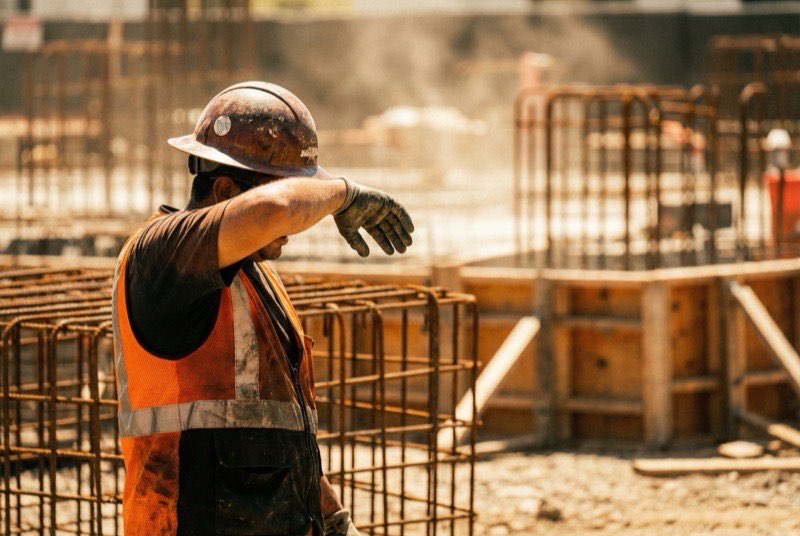
The numbers back this up. Between 2011 and 2020, OSHA reported 33,890 heat injuries and illnesses involving days away from work, an average of 3,389 per year. A 2025 study from George Washington University and Harvard estimated approximately 28,000 excess workplace injuries in the US are linked to hot weather every single year. That number is likely an undercount.
And OSHA is paying attention. The agency launched its Heat National Emphasis Program (NEP) in April 2022 and extended it through April 2026. Between launch and December 2024, OSHA conducted approximately 7,000 heat-related inspections, issued 60 heat citations, and sent 1,392 Hazard Alert Letters to employers. In 2024 alone, heat-related penalties exceeded $2 million.
Here is the blunt truth: most of these injuries and deaths are preventable. The workers who die from heat stroke are almost always new workers who were not acclimatized, workers who did not have access to water and shade, or workers whose symptoms were ignored until it was too late.
Heat illness is not a single condition. It is a progression, and understanding the stages is the difference between catching a problem early and calling an ambulance.
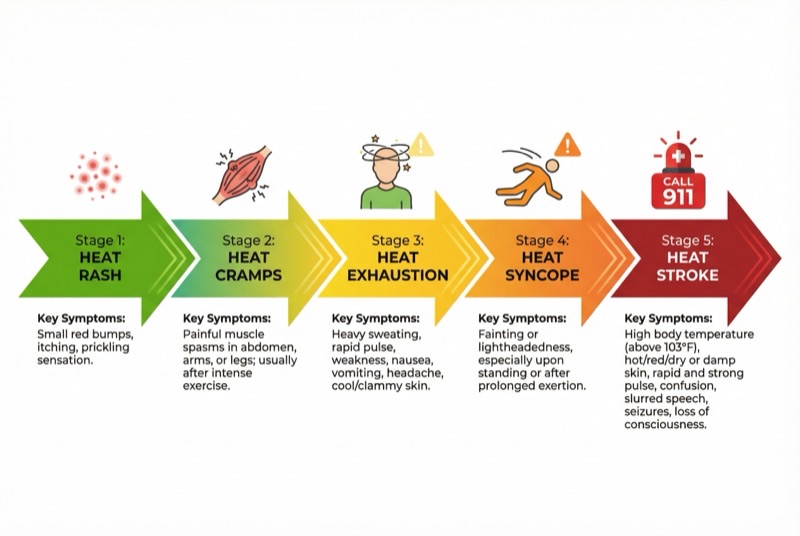
Most people think heat stroke comes out of nowhere. They are wrong. Heat illness almost always follows a predictable escalation, and each stage gives you a warning before the next one hits:
Stage 1: Heat rash. Red spots, severe itching, blocked sweat glands. Common in hot, humid conditions. Annoying but not dangerous. It is your body's first signal that heat is winning.
Stage 2: Heat cramps. Sharp muscle pains from salt imbalance and heavy sweating. The worker can still function, but their body is telling them to stop, hydrate, and rest.
Stage 3: Heat exhaustion. This is where things get serious. Symptoms include heavy sweating, weakness, dizziness, nausea, headache, and pale or clammy skin. The body is still trying to cool itself, but it is losing the battle. If you catch it here, a cool-down break and fluids usually resolve it.
Stage 4: Heat syncope. Dizziness and fainting caused by insufficient blood flow to the brain. Most common in unacclimatized workers who have been standing in the heat. The worker goes down suddenly.
Stage 5: Heat stroke. Medical emergency. Body temperature exceeds 40°C (104°F). Confusion, slurred speech, loss of consciousness, hot and dry skin (or profuse sweating in exertional heat stroke). Call 911 immediately. Delayed treatment can result in death or permanent organ damage.
The workers at highest risk include those over 45, those with heart disease or diabetes, those on certain medications (diuretics, beta-blockers, antihistamines), those who are overweight, and anyone who is not acclimatized to the heat. Workers wearing heavy PPE, including fire-resistant coveralls in oil and gas operations, face compounded risk because their gear traps body heat.
Prevention works. But "tell your guys to drink water" is not a heat stress prevention program. Here are the five controls that actually prevent heat illness on job sites, backed by NIOSH recommendations and enforcement data.
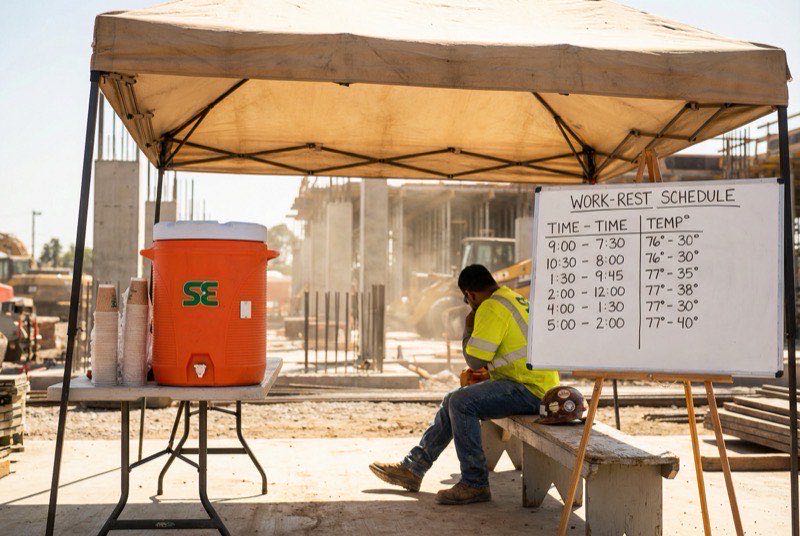
The standard is specific: 1 quart (32 oz) of cool drinking water per worker per hour when heat conditions are present. Not a water jug on the tailgate 200 metres away. Water must be readily accessible at the work location, cool (not ice cold, which can cause cramps), and available in sufficient quantity for the entire crew.
The biggest mistake? Relying on workers to self-hydrate. By the time a worker feels thirsty, they are already dehydrated. Build water breaks into the schedule. Monitor urine colour: pale yellow means hydrated, dark yellow means the worker is already behind.
Work-rest cycles are the most effective administrative control for heat stress. The schedule depends on three variables: heat index, work intensity (metabolic rate), and clothing/PPE.
California's Cal/OSHA standard (§3395) provides a benchmark: shade must be available when the temperature exceeds 80°F, and high-heat procedures kick in at 95°F. OSHA's proposed federal rule would require 15-minute paid rest breaks every two hours once the heat index hits 90°F.
Shade structures, air-conditioned trailers, or cooling stations should be set up before work begins, not after someone goes down. Schedule the heaviest physical tasks for early morning or late afternoon when temperatures are lower.
This is the control most employers skip, and it is the one most directly linked to heat deaths. The majority of heat-related fatalities occur in the worker's first few days on the job or first few days of a heat wave.
NIOSH's acclimatization protocol is straightforward:
Here is what this looks like on a real job: a new labourer starting in July does not get a full 8-hour shift on a roofing crew on Day 1. They work 1.5 hours in the heat, then rotate to a shaded task. Day 2, they get 3 hours. By Day 5, they are working a full shift. It is inconvenient. It also prevents the scenario where a 19-year-old collapses on his third day because nobody told him his body needed time to adapt.
Training is not a PowerPoint deck in February. Effective heat stress training means every worker and supervisor on site can recognize the symptoms of heat exhaustion versus heat stroke, knows the buddy system protocol, and understands the emergency response chain.
Key training elements:
Run a heat stress toolbox talk before the first hot week of the season, then monthly through September. A 5-minute refresher at the morning tailgate meeting is worth more than a 2-hour classroom session in January.
You cannot manage what you do not measure. Monitor the heat index or wet bulb globe temperature (WBGT) at the actual work location, not the nearest airport weather station. A site with no wind, black asphalt, and a generator running is significantly hotter than the temperature your phone reports.
Pair environmental monitoring with human monitoring. Buddy checks every 30 minutes during high-heat conditions. Two-way radios or check-in systems for lone workers. Supervisors trained to pull a worker off the line if they see early symptoms, even if the worker says they are fine.
Build Your Heat Stress Prevention Program with SE AI
Generate site-specific heat illness prevention plans, acclimatization schedules, and toolbox talks that match your crew size, location, and industry.
Get Early Access to SE AI →As of April 2026, there is no federal OSHA standard specific to heat stress. That does not mean there is no enforcement. OSHA uses the General Duty Clause, Section 5(a)(1) of the OSH Act to cite employers for heat hazards. Serious violations carry penalties up to $16,550, and willful or repeated violations can reach $165,514 per violation.
OSHA published a Notice of Proposed Rulemaking (NPRM) on August 30, 2024, for a comprehensive heat standard titled "Heat Injury and Illness Prevention in Outdoor and Indoor Work Settings." The proposed rule received over 43,000 public comments and went through an informal hearing in June and July 2025. However, the rule is currently paused under the administration's "Regulatory Freeze Pending Review" issued in January 2025. Its future depends on Senate confirmation of OSHA's new leadership.
Regardless of the proposed rule's status, the OSHA Heat National Emphasis Program remains active through April 2026, and OSHA continues to enforce heat hazards through the General Duty Clause. Five states have already enacted their own heat standards: California, Oregon, Washington, Colorado, and Minnesota. If you operate in any of these states, you have specific compliance obligations that go beyond federal requirements.
The proposed federal rule, if finalized, would establish two trigger levels: an initial heat trigger at 80°F (heat index) requiring water, shade, acclimatization, and rest breaks, and a high heat trigger at 90°F requiring additional protections including 15-minute paid rest breaks every two hours, mandatory symptom monitoring, and a buddy system. Employers would also need a written Heat Injury and Illness Prevention Plan (HIIPP).
Canadian employers face a different regulatory landscape. No province has a specific temperature threshold that triggers heat stress protections. Instead, the general duty to provide a safe workplace applies across all jurisdictions, and most provinces reference the ACGIH Threshold Limit Values (TLVs) for heat stress as guidelines.
The most significant regulatory development is the new federal thermal stress amendment published in February 2026 under Section 10.19, Part X (Hazardous Substances) of the Canada Occupational Health and Safety Regulations. This amendment requires federally regulated employers to control exposure to extreme heat when ACGIH thresholds are reached and to develop procedures with workplace committee input. It is expected to take effect in approximately February 2027.
At the provincial level:
The gap between Canadian guidance and enforceable standards means employers need to build their heat programs proactively, using ACGIH TLVs and CCOHS guidelines as the baseline, rather than waiting for prescriptive regulation.
Every site needs a heat illness emergency response plan before the first hot day, not during it. Here is what that plan looks like in practice.
For heat exhaustion:
For heat stroke:
After any heat illness incident: document everything. Under OSHA's recordkeeping requirements (29 CFR 1904), heat-related illnesses requiring medical treatment beyond first aid must be recorded. Fatalities must be reported within 8 hours and hospitalizations within 24 hours. In Canada, report to your provincial workers' compensation board and conduct a root cause investigation.
Need a Heat Illness Response Plan Your Crews Will Actually Follow?
SE AI generates site-specific emergency procedures, acclimatization schedules, and training materials, ready before the first heat wave.
Get Early Access to SE AI →There is no single "stop work" temperature. The risk depends on heat index, humidity, work intensity, PPE, and acclimatization status. OSHA's proposed triggers are 80°F for initial protections (water, shade, acclimatization) and 90°F for enhanced protections (mandatory rest breaks, buddy system). California's Cal/OSHA standard requires shade at 80°F and high-heat procedures at 95°F.
NIOSH recommends 5 to 7 days for new workers using the 20% rule: no more than 20% of heat exposure on Day 1, increasing by 20% each additional day. Workers returning after 7 or more days away should start at 50% and increase by 10% daily. Full acclimatization can take up to 14 days depending on individual fitness, medical conditions, and heat severity.
Heat exhaustion involves heavy sweating, weakness, dizziness, and nausea. The body is still trying to cool itself. Heat stroke means the cooling system has failed: body temperature exceeds 40°C (104°F), the worker shows confusion or loss of consciousness, and skin may be hot and dry. Heat stroke is a medical emergency requiring an immediate 911 call. Heat exhaustion can progress to heat stroke if untreated.
Not yet. OSHA proposed a comprehensive federal heat standard in August 2024, but it is currently paused under regulatory review. However, OSHA actively enforces heat hazards through the General Duty Clause, with penalties up to $16,550 per serious violation and $165,514 for willful violations. The OSHA Heat National Emphasis Program has resulted in over 7,000 inspections and $2 million in penalties since 2022. Five states (California, Oregon, Washington, Colorado, and Minnesota) have their own heat standards.
Early signs include heavy sweating, muscle cramps, dizziness, headache, and fatigue. As heat stress worsens, watch for nausea, visual disturbances, rapid pulse, irritability, and coordination problems. Any worker showing confusion, slurred speech, or loss of consciousness needs emergency medical attention immediately. Train all workers and supervisors to recognize these signs and implement a buddy system for monitoring during hot conditions.
Get Weekly Safety Insights
Regulation updates, toolbox talk ideas, and compliance tips. One email per week.
Learn the 5 stages of heat illness, from heat rash to heat stroke. Spot symptoms early, respond fast, and know when to call 911 on your job site.
Safety meetings cut injury costs 20-40%. Learn the 5 types, US + Canadian legal requirements, and how to run meetings crews actually pay attention to.
Federal OSHA doesn't require safety meetings, but 14+ states do. State-by-state requirements, Cal/OSHA's 10-day rule, and why you need them anyway.