Last updated: May 2026
If your team keeps seeing the same hazard on back-to-back shifts, you do not have a hazard problem. You have a closeout problem. Field safety corrective actions are documented hazard fixes with a named owner, due time, and verified closure evidence. That is different from medical-device FSCA language and different from a quick verbal reminder at lineup. This guide shows how to run field closeout so hazards are corrected before the next shift starts, with a practical workflow that ties directly to your corrective action plan template for safety teams.
A blunt truth: most crews do not fail because they miss hazards. They fail because ownership is vague, proof is missing, and "done" gets accepted without verification. If you want fewer repeat hazards, your closeout standard has to be tighter than your hazard log.
⚡ Quick Answer
- What it is: A field safety corrective action is a documented fix for a hazard, assigned to one owner, completed by a due time, and verified before closure.
- Workflow: Identify hazard, assign owner and deadline, apply interim controls, implement permanent fix, verify effectiveness, then close with evidence.
- US reporting trigger: OSHA requires reporting within 8 hours for a fatality and 24 hours for in-patient hospitalization, amputation, or loss of an eye (29 CFR 1904.39).
- US abatement context: OSHA citation handling requires hazards to be abated and verified (29 CFR 1903.19).
- Canada context: WorkSafeBC Part 3 requires regular inspections and prompt correction of unsafe conditions.
If you want a cleaner way to run this in the field, start a 30-day free trial to assign owners, set due dates, capture evidence, and verify closeout before handover.
What Counts as a Field Safety Corrective Action (and What Does Not)?
A field safety corrective action is not a note that says, "watch your step." It is a risk-reduction action tied to a specific hazard, assigned to one accountable person, completed by a specific time, and verified by someone with authority to close it. If one of those pieces is missing, it is not closed.
Use this distinction in the field:
- Interim control: Temporary risk reduction right now, like barricading, lockout, or access restriction.
- Corrective action: The permanent fix that removes or materially reduces the hazard at source.
- Preventive action: System improvement that reduces recurrence across similar tasks, crews, or sites.
Most people think "talked to the crew" counts as closure. It does not. Communication helps, but without physical correction and verification evidence, you are carrying open risk into the next shift.
How Should the End-of-Shift Corrective Action Workflow Run?
This is the practical sequence supervisors can run before handover. It works because each step has one owner, one timestamp, and one output.
Before rollout, define owner and supervisor responsibilities inside your corrective action software workflow so every hazard has one accountable owner, one due time, and one verification record. Then reinforce execution with practical references like the field level hazard assessment example and digital field level hazard assessment workflow.
Step 1-2, Capture the hazard and assign a single owner
Record hazard description, exact location, exposure type, and time identified. Then assign one owner, not "crew" or "team." If ownership is shared, accountability is gone. Tie the action to related records like your field level hazard assessment example or digital field level hazard assessment workflow so traceability survives audits.
Step 3-4, Apply interim controls and execute the permanent fix
Apply interim controls immediately if exposure exists now. Then execute the permanent fix with a deadline that matches risk severity and operational reality. Illustrative field example: a damaged stair tread is identified mid-shift, isolated immediately, repaired before handover, then reopened only after supervisor verification with photo evidence and a closure timestamp. The next shift inherits a corrected condition, not a warning note.
Step 5-6, Verify in the field and close with evidence
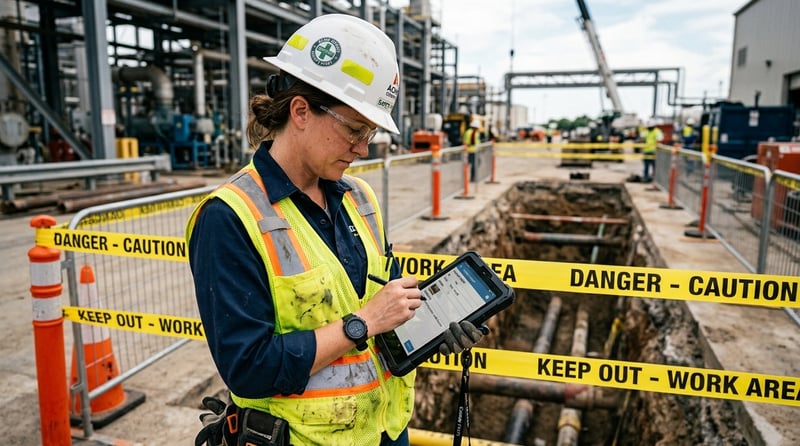
Verification is a field check, not a desk click. Confirm the hazard condition is corrected, affected workers are informed, and controls are functioning. Close only when evidence is attached: before and after photos, closure timestamp, verifier name, and effectiveness note. If completion misses shift-end cutoff, escalate with an explicit carryover owner and next verification time, the same standard you should apply in higher-risk contexts like stop-work orders in construction.
Open hazards should not roll into the next shift
If ownership, deadlines, and closure proof are spread across texts, spreadsheets, and paper notes, follow-through breaks. Run one field workflow and close hazards with evidence before handover.
Start Your 30-Day Free Trial →
What Closeout Evidence Is Non-Negotiable for Audits and Regulator Follow-Up?
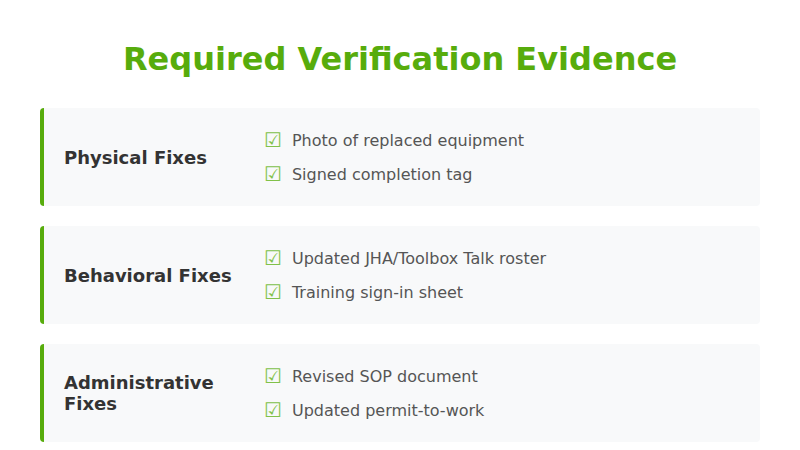
If you cannot produce closure evidence fast, your action is functionally open. Use these three evidence categories:
- Physical Fixes: Photo of replaced equipment; Signed completion tag.
- Behavioral Fixes: Updated JHA/Toolbox Talk roster; Training sign-in sheet.
- Administrative Fixes: Revised SOP document; Updated permit-to-work.
This is where weak systems collapse. If your verification note says "resolved" with no evidence, auditors and investigators will treat that as unverified. Pair this workflow with stronger investigation quality using incident investigation process for contractors and deeper recurrence control through root cause analysis for safety incidents.
In Canada, What Program Duties Govern Corrective Actions?
In Canada, treat corrective-action timelines as provincial compliance obligations, not generic best practice. For example, WorkSafeBC OHS Regulation Part 3 requires regular inspections and prompt correction of unsafe conditions. Your closeout system should be able to show who found the issue, what was corrected, and when correction was verified.
CCOHS guidance also reinforces internal responsibility system expectations, where employers, supervisors, and workers each have active safety duties. Operationally, that means corrective actions cannot sit in a "safety inbox" with no accountable field owner. Keep one owner per action and one verifier per closure event.
In the US, How Do OSHA Reporting and Abatement Rules Affect Field Closeout?
In the US, your corrective-action records need to support fast compliance response. Under OSHA 29 CFR 1904.39, fatalities are reportable within 8 hours, and in-patient hospitalization, amputation, or loss of an eye is reportable within 24 hours. If your event-response details are scattered, you will lose time you do not have.
OSHA 29 CFR 1903.19 centers on abatement verification. OSHA 29 CFR 1926.20 also requires employers to maintain safety programs and frequent, regular inspections by competent persons. Translation for operations teams: closeout data has to be retrieval-ready, evidence-backed, and tied to inspection activity, not buried in email threads.
Which KPIs Tell You if Corrective Actions Are Actually Working?
Count outcomes, not activity. These four KPIs expose whether your process is reducing real risk:
- Open actions by age bucket: 0-24h, 24-72h, 72h+.
- Overdue corrective action rate: Overdue actions divided by total open actions.
- Verification lag: Time from fix completion to verified close.
- Repeat hazard rate: Recurrence by task, equipment, or crew within 30 days.
If repeat hazards stay high while "closed" count looks good, your closure standard is cosmetic. Tighten verification criteria before adding more training hours.
24-Hour Rollout: Put This Process in Place on Your Next Shift
First 4 hours: Standardize required fields, assign supervisor and verifier roles, set escalation rules for missed shift-end closure.
Next 8 hours: Run the workflow on all currently open hazards, prioritize by exposure severity, and enforce one-owner assignment.
End of shift: Review overdue items, confirm interim controls on carryovers, publish next-shift closure commitments with owner names.
Next-day start: Check recurrence on prior-day closures, validate evidence quality, and remove any closure that fails verification standards.
Run corrective actions with proof, not promises
When every hazard has one owner, one due time, and verified closure evidence, you stop handing open risk to the next crew. Put the process in place and test it on your next shift.
Start Your 30-Day Free Trial →
Frequently Asked Questions
What is the difference between a corrective action and an immediate fix?
An immediate fix is temporary risk reduction used to control exposure right away. A corrective action is the permanent solution that addresses the hazard condition, then gets verified and documented before closure.
Who should approve closure on field safety corrective actions?
The person closing the action should be a designated verifier with authority to confirm the hazard is corrected in the field. The action owner should not self-approve closure without verification evidence.
What evidence is enough to close a hazard in construction or industrial work?
At minimum, keep hazard details, owner and due time, before and after photos, verifier name, verification timestamp, and a note confirming effectiveness. If that package is incomplete, closure is weak.
What if the corrective action cannot be completed before shift handover?
Escalate it before handover with interim controls, a named carryover owner, and a next verification time. Do not mark it closed just because the shift ended.
Can one corrective action workflow work in both Canada and the US?
Yes, the operational workflow can be shared, but legal requirements must be mapped by jurisdiction. Keep Canadian provincial obligations and US OSHA requirements clearly separated in your compliance layer.
How do I reduce repeat hazards after actions are marked complete?
Track repeat hazard rate by task, equipment, and crew, then tighten closure criteria where recurrence is high. Repeat events usually signal weak verification, not weak logging.
Get Weekly Safety Insights
Regulation updates, toolbox talk ideas, and compliance tips. One email per week.