Training
H2S Alive: Training Guide for Canadian Workers
H2S Alive costs $150-$250, takes one day, and lasts 3 years. Here's what to expect, who needs it, and how to choose a provider.
Corrective action request software for contractors: assign owners, due dates, evidence, and verified closeout in one workflow. Start a 30-day free trial.
Last updated: May 2026
Most corrective actions do not fail because crews ignore safety. They fail because the system does not force clear ownership, proof, and verification before closure. A spreadsheet can list tasks, but it cannot reliably enforce escalation, retrieval speed, or closeout quality across active jobsites.
Corrective action request software is a contractor workflow system that tracks each hazard fix from assignment to verified closure, with owner, due date, evidence, and effectiveness checks in one audit trail. If your team has ever been asked for closeout proof and needed 30 minutes of email digging, this is exactly where software design matters. We will also map Canada and US compliance expectations in separate sections, with no jurisdiction mixing.
Start by moving corrective actions out of paper, spreadsheets, and scattered follow-ups into one software workflow with owner assignment, due dates, evidence capture, and verified closeout.
If you want a practical starting point, start a 30-day free trial to standardize owner assignment, due dates, evidence capture, verification, and multi-site status tracking.
CAR software is not just a digital task list. It is a control system for risk reduction work that has to stand up during audits, incidents, and client reviews. Generic project tools are useful for scheduling, but they usually miss core safety controls like verifier gates, evidence requirements, and overdue escalation logic.
Most people think a shared spreadsheet is good enough because everyone can see it. They are wrong. Visibility is not accountability. If one row can be marked complete without evidence, your closeout metric is inflated and your risk is still on site.
Contractor environments also need mobile-first capture. Foremen and supervisors need to assign actions, upload photos, and confirm interim controls from the field, not after shift in an office. A practical system also gives operations and safety one common view before handover, so no one inherits open hazards by surprise.
A messy example we see often: a subcontractor crew flags a damaged ladder cage during a turnaround, someone marks it "done" in a sheet, then night shift finds only caution tape and no repair. The action looked closed. The hazard was still live. Good CAR software blocks that failure with verification requirements.
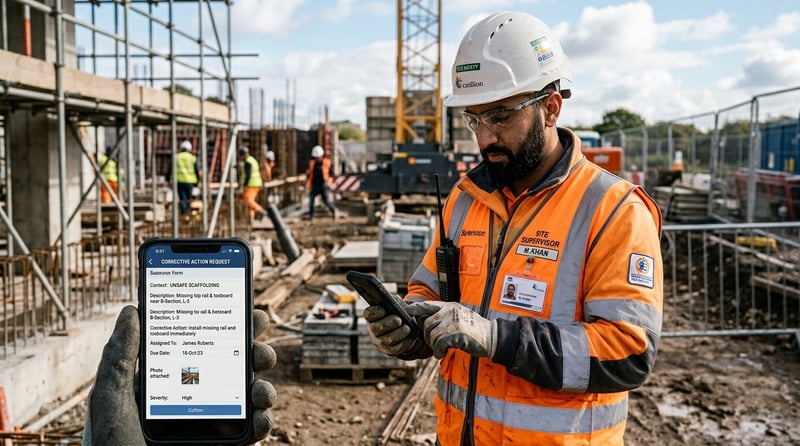
If your data model is weak, your workflow will be weak. These 12 fields are the minimum set for contractor operations that need defensible closeout and fast retrieval.
Blunt truth: if your vendor demo does not show these fields natively or through configurable forms without brittle workarounds, you are buying future cleanup work, not control.
Move CAR workflows out of spreadsheets and into one accountable system
Track corrective actions from assignment to verified closeout. Use Safety Evolution to assign owners, capture evidence, and see what is overdue across every site. Start your 30-day free trial.
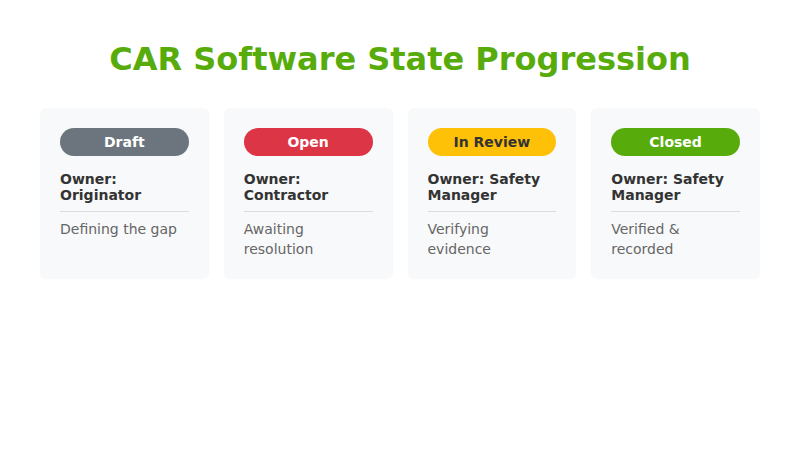
Start Your 30-Day Free Trial →Fields alone do not create control. State logic does. Your software should enforce a fixed lifecycle so teams cannot skip verification or hide overdue work.
Transition rules matter. For example, only assigned owners should move New to Assigned, and only designated verifiers should move Ready for Verification to Verified. Every state change should log timestamp, actor identity, and reason code for traceability.
This is where related workflows should connect cleanly. Your CAR state model should link with your field safety corrective action closeout workflow and investigation quality process like root cause analysis with a proven template.
In Canada, correction speed and follow-up records are core expectations. WorkSafeBC OHS Regulation 3.9 requires unsafe or harmful conditions to be corrected without delay. WorkSafeBC 3.10 requires reported unsafe conditions to be investigated and corrected without delay.
That means your CAR records should quickly show who owned the correction, when interim controls started, what permanent fix was implemented, what evidence supports completion, and who verified it. CCOHS investigation guidance also supports this logic by emphasizing cause identification, corrective planning, and effectiveness follow-up.
For multi-site contractors, storing jurisdiction and site in the action record prevents teams from applying the wrong references during inspections. Keep the record complete enough that a supervisor can retrieve a defensible closeout package without rebuilding the story from memory.
In the US, time pressure is non-negotiable. OSHA requires reporting a work-related fatality within 8 hours, and in-patient hospitalization, amputation, or loss of an eye within 24 hours. Your workflow needs fast retrieval for event details and action status.
OSHA 1926.20 requires construction employers to initiate and maintain safety programs and perform frequent and regular inspections by competent persons. OSHA 1903.19 adds abatement verification implications when citations require correction. CAR software should support these realities with timestamped actions, evidence links, and easy export.
Penalty exposure reinforces the business case. Current OSHA maximums are $16,550 per serious violation, $165,514 per willful or repeated violation, and $16,550 per day for failure to abate. If your system cannot surface overdue high-risk actions early, you are accepting avoidable exposure.
Use this scorecard to compare vendors quickly, then pressure-test your top two options with real corrective action records.
Red flags to reject fast: no verifier field, no overdue escalation owner, no effectiveness review date, or closure states that can be bypassed by any user.
A short rollout beats a perfect rollout that never starts. Use a four-week implementation sprint with strict ownership.
Do not skip the retrieval drill. Ask a supervisor to pull five closed actions from mixed sites while someone times the process. If retrieval fails, the configuration is not done.
For cluster planning support, connect this rollout with your CAR performance dashboard and review aging, recurrence, and verification lag by site each week.
Replace spreadsheet closeout with contractor-ready CAR workflow control
Run owner assignment, due-date escalation, evidence capture, and verification in one system your field teams and safety leaders can trust.
Start Your 30-Day Free Trial →Incident reporting software captures event details and initial notifications. Corrective action request software manages ownership, due dates, implementation, evidence, and verification from open action to validated closeout.
Legal requirements vary by jurisdiction and trigger, but operations should still enforce owner, due date, evidence, verifier, and effectiveness fields. Those fields are what make records inspection-ready and recurrence-resistant.
Verification should happen as soon as practical after implementation, especially for high-risk exposures. In contractor operations, same shift or next shift verification is a strong standard for critical hazards.
Yes, one workflow can serve both markets if it stores jurisdiction context and keeps compliance references separated by lane. The core data model can be shared while regulatory expectations remain clearly segmented.
At minimum, keep owner, due date, corrective action details, before and after evidence, verifier name, and verification timestamp. Without that package, closeout quality is weak and hard to defend during audits.
Use state gates that require evidence and independent verification before closure, then schedule effectiveness reviews to catch recurrence. If closure can happen without a verifier, teams will eventually close actions on assumption.
Get Weekly Safety Insights
Regulation updates, toolbox talk ideas, and compliance tips. One email per week.
H2S Alive costs $150-$250, takes one day, and lasts 3 years. Here's what to expect, who needs it, and how to choose a provider.
Alberta's OHS Code Part 5 sets strict confined space rules. Learn the definitions, entry permits, atmospheric testing, and rescue requirements your...
Learn how to create a comprehensive emergency response plan to ensure workplace safety and protect your employees in case of emergencies.