Last updated: May 2026
If you have ever closed an incident file and then watched the same hazard show up two weeks later, your corrective action process is broken. Most teams do the investigation, write a few vague actions, and move on. Then supervisors chase overdue items in spreadsheets while crews repeat the same exposure.
A corrective action plan is a documented process that turns a safety finding into specific, owned, time-bound actions with verification evidence so the risk does not recur. This guide is built for contractor operations, not quality-manual theory. You will get the exact workflow, required fields, and separate Canada and US compliance lanes.
⚡ Quick Answer
- What: A corrective action plan connects incident findings to owned fixes, due dates, and closure proof so hazards do not repeat.
- US deadlines: OSHA requires reporting a work-related fatality within 8 hours, and inpatient hospitalization, amputation, or loss of an eye within 24 hours.
- US record access: Under OSHA 1904.40, required Part 1904 records must be provided within 4 business hours when requested by an authorized government representative.
- Canada currency: Alberta OHS Code updates are fully in effect as of March 31, 2025, and the federal Canada Labour Code page is current to 2026-03-17.
- Execution rule: Good CAPs are specific, observable, and verifiable. “Retrain staff” alone is not a corrective action.
What Is a Corrective Action Plan in Safety Operations?
In contractor safety operations, a corrective action plan is the bridge between your safety incident investigation process and real field change. It tells your team exactly what gets fixed, who owns it, when it is due, and how closure will be proven.
Most people think a corrective action is just “do more training.” They are wrong. Training can support a fix, but if your hazard control did not change in the field, you did not correct anything. A proper CAP can include engineering controls, administrative changes, supervision changes, and competency reinforcement.
Use CAPs for incidents, near misses, inspections, audit findings, and worker-reported hazards. If your crew flags a line-of-fire risk at a loading area and you only send a reminder email, expect that risk to come back. A CAP forces a stronger standard: concrete action, accountable owner, and evidence at closeout.
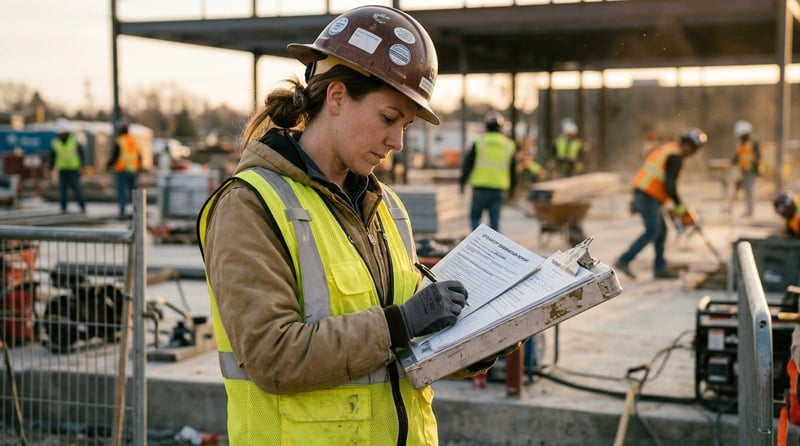
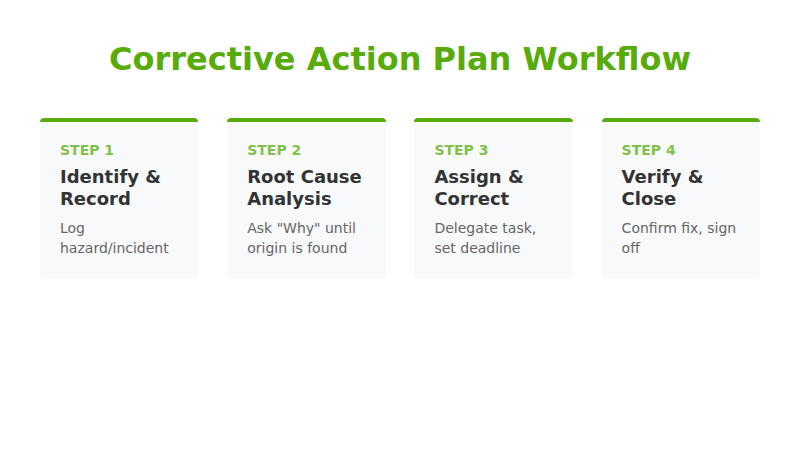
What Is the 4-Step Corrective Action Workflow (From Finding to Verified Closure)?
Here is the practical workflow that works on active projects and during turnaround pressure. Follow it in order, and do not close actions without evidence.
Step 1: Identify & Record
Log the event immediately with severity, exposure, and location. Separate critical controls that need same-shift intervention from items that can be scheduled. Tie this to your near miss reporting process so weak signals are not ignored.
Step 2: Root Cause Analysis
Validate why the event occurred, not just what happened. Use your root cause analysis for safety incidents method and confirm contributing factors like planning gaps, supervision failures, or incompatible procedures.
Step 3: Assign & Correct
Build controls in priority order, assign one accountable owner role per action, set due date and escalation path, then execute the field correction where exposure exists.
Step 4: Verify & Close
Require closure evidence such as updated procedure, photos of control installation, and verifier sign-off. Close only when criteria are met and schedule a recurrence checkpoint.
Still managing corrective actions in scattered spreadsheets?
Ready to move corrective actions out of spreadsheets? Start your 30-day free trial of Safety Evolution and manage owners, due dates, evidence, and verification in one digital workflow.
Start Your 30-Day Free Trial →
What Should You Include in Every Corrective Action Plan (Required Fields)?
A usable CAP template is not complicated, but every field matters. If you skip one, closeout quality drops and repeat incidents go up.
- Finding reference ID: Incident, inspection, or audit identifier.
- Hazard and exposure summary: Who was exposed, where, and under what conditions.
- Root cause statement: Confirmed cause and contributing factors.
- Corrective action statement: Specific and observable control change.
- Owner role: One accountable owner per action.
- Due date and priority: Target date aligned to risk severity.
- Interim controls: Temporary protections until full closure.
- Verification method: Required evidence type and acceptance criteria.
- Closure approver and date: Who signs off and when.
- Recurrence window: 30, 60, or 90-day follow-up checkpoint.
This mirrors strong regulatory template logic. For example, Health Canada corrective action templates require clear root cause, action ownership, timelines, and supporting evidence.
What Do Bad vs Good Corrective Actions Look Like in the Field?
Below is the quality line most teams miss. Weak actions describe effort. Strong actions describe control change and verification.
| Scenario |
Weak Action |
Strong Action |
| PPE non-use |
Retrain staff on PPE policy. |
Issue fit-tested PPE, add pre-task PPE check at shift start, and require supervisor verification logs for 14 days. |
| Line-of-fire exposure |
Remind workers to stay clear. |
Install exclusion-zone barriers, revise lift plan with spotter position controls, and verify with two observed lifts per crew. |
| Lockout gap |
Review lockout policy in toolbox talk. |
Deploy machine-specific lockout checklist, assign maintenance lead sign-off, and audit 100% of lockouts for 30 days. |
| Vehicle spotter failures |
Tell drivers to use spotters. |
Implement one-way traffic lanes, mandatory radio call protocol, and end-of-week spot-check report signed by superintendent. |
In Canada: How Corrective Actions Fit OHS Duties and Incident Follow-Up
For Canadian operations, corrective action obligations sit inside provincial OHS duty frameworks and incident follow-up expectations. Treat CAP records as inspection-ready evidence, not internal notes.
Currency matters. Alberta confirms OHS Code updates are fully in effect as of March 31, 2025. Federally regulated employers should also note the Canada Labour Code page is current to 2026-03-17 and last amended 2025-12-12.
CCOHS investigation guidance is clear: incident investigations are fact-finding exercises designed to identify causes and prevent recurrence. Your CAP should reflect that by linking findings to controls, owners, timelines, and closure proof. If an officer asks for your follow-up trail, you should be able to produce it immediately.
In the US, Which OSHA Reporting and Record Access Timelines Affect CAP Execution?
US employers need CAP execution that aligns with OSHA reporting and records timelines. If your corrective action system is slow, you will miss critical deadlines or fail to produce evidence during review.
Under OSHA 1904.39, report a work-related fatality within 8 hours. Report inpatient hospitalization, amputation, or loss of an eye within 24 hours. Under OSHA 1904.40, required Part 1904 records must be provided within 4 business hours when requested by an authorized government representative.
OSHA incident investigation guidance also emphasizes root-cause-focused, non-blame analysis. That only works if your CAP workflow captures causes, assigns accountable owners, and stores closure evidence in one retrievable system.
Which CAP KPIs Show Whether Corrective Actions Are Actually Working?
You cannot manage CAP quality by “number of actions closed” alone. Track operational KPIs that show whether risk is actually decreasing.
- Open-action aging buckets: 0-7, 8-14, 15-30, and 30+ days.
- Overdue action rate: Percent of actions past due by site and supervisor.
- Average CAP cycle time: Days from finding logged to verified closure.
- Repeat incident rate: Recurrence by hazard type after closeout.
- Verification pass rate: Percent of actions that pass first closeout review.
Treat these KPI thresholds as internal operating targets unless your regulator or client contract sets stricter standards.
Link these KPIs back to your field safety corrective actions guide so leadership sees trend movement, not isolated task completions.
How Should You Implement a Corrective Action Plan in the Next 30 Days?
If you want this running fast, use a four-week rollout with hard ownership checkpoints.
- Week 1: Standardize CAP form fields and severity triage rules.
- Week 2: Train supervisors on action quality criteria and closure evidence expectations.
- Week 3: Launch owner and due-date tracking with an escalation rhythm for overdue items.
- Week 4: Audit your first closure batch, tune weak actions, and lock the standard.
Do not wait for perfect software configuration before starting. But do move out of ad hoc spreadsheets quickly if you want consistent closeout quality.
Run corrective actions in one system, not five disconnected files
When actions, owners, and closure proof live in one workflow, teams close hazards faster and walk into inspections with confidence. Start your 30-day trial and operationalize CAP execution.
Start Your 30-Day Free Trial →
Frequently Asked Questions
What is the difference between corrective action and preventive action?
Corrective action addresses a confirmed finding or incident that already happened. Preventive action reduces the chance of a future issue before an event occurs. In practice, strong CAPs include both immediate correction and prevention controls.
Who should own a corrective action plan on a construction project?
Each action should have one accountable owner, usually a supervisor, superintendent, or functional lead with authority to implement controls. Safety teams should set standards and verify closure, but ownership should sit with operations.
How fast should corrective actions be closed after an incident?
Close timing should match risk severity. Critical exposures should get immediate interim controls and accelerated deadlines, often same shift or within 24 hours. Lower-risk findings can follow standard due dates but still require verified closure evidence.
What evidence is enough to close a corrective action?
At minimum, closure evidence should include proof the control was implemented, confirmation it works in the field, and approver sign-off. Typical evidence includes updated procedures, photos, inspection records, and supervisor verification notes.
Can one CAP template work for both Canada and the US?
Yes, the core CAP fields can stay the same across both markets. You should still separate jurisdiction-specific compliance references, reporting timelines, and documentation expectations inside your procedure so teams follow the correct legal lane.
What happens if corrective actions are overdue during an inspection?
Overdue high-risk actions can indicate ineffective hazard control and weak supervision systems. During inspections or investigations, that can increase scrutiny, enforcement exposure, and confidence risk with clients, primes, and regulators.
Get Weekly Safety Insights
Regulation updates, toolbox talk ideas, and compliance tips. One email per week.