Last updated: May 2026
If your crew signs a hazard form once and never updates it, the form is paperwork, not prevention. A job safety analysis template is a step-by-step planning form that breaks work into tasks, identifies hazards at each step, and assigns controls and ownership before work starts. On busy construction sites, teams may call this JSA, JHA, or FLHA. The label can change by client. The workflow should not.
⚡ Quick Answer
- What this gives you: A field-ready template structure plus a filled construction example you can copy today.
- Naming reality: JSA, JHA, and FLHA often describe the same pre-task hazard workflow, with regional/client naming differences.
- US compliance anchor: OSHA requires instruction on recognition and avoidance of unsafe conditions (29 CFR 1926.21(b)(2)) and PPE hazard assessment with written certification (29 CFR 1910.132(d)).
- Canada compliance anchor: WorkSafeBC requires regular inspections (OHS 3.5) and correction of unsafe conditions without delay (OHS 3.9), while CCOHS uses hazard ID, risk assessment, then controls.
- When to update: Revise the form whenever crew, equipment, sequence, or site conditions change.
JSA vs JHA vs FLHA: What to Call It on Your Site
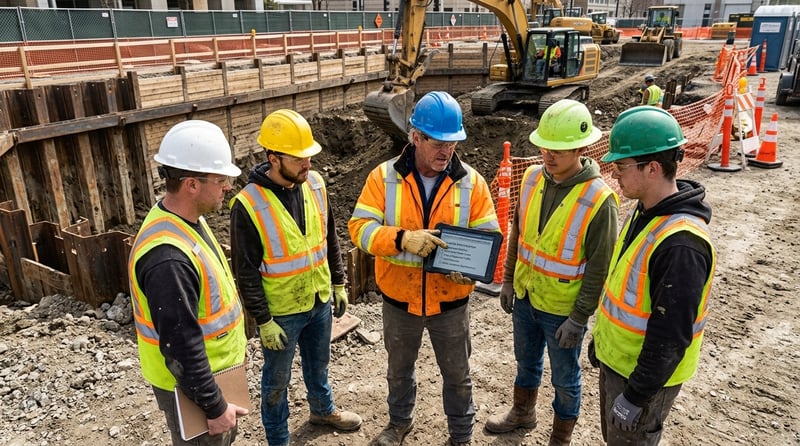
Most teams use these terms interchangeably in field operations. OSHA guidance references job hazard analyses, also known as job safety analyses, in hazard identification workflows. CCOHS also reflects naming variation across organizations.
Use this working rule. Follow the label required by the client, prime, or regulator-facing document. Keep one internal process for your supervisors and crews. Changing terminology is fine. Changing process quality is not.
US readers: You will usually see JSA or JHA in project and contractor language. Western Canada readers: You will often see FLHA or JHA in field practice. If you need a deeper implementation walkthrough, read this digital FLHA guide.
For the full workflow context, use this companion guide: digital field level hazard assessment.
Job Safety Analysis Template (Blank): Fields You Need
A usable template is short, specific, and built for a pre-task huddle. If the form is too complex, crews stop using it under production pressure.
At minimum, include these metadata fields: task name, location, date, crew members, and supervisor or competent person responsible for approval.
Then include these operating columns for each task step:
Task step: Observable action in sequence.
Hazard: What can hurt people or damage assets at this step.
Likelihood: How likely the incident is if no additional control is applied.
Severity: Consequence level if the event occurs.
Risk rating: Simple matrix output based on likelihood and severity.
Controls: Measures selected using hierarchy, engineering then administrative then PPE as needed.
Owner: Named role accountable for each control.
Verification/signoff: Evidence that controls were briefed and implemented.
Job Safety Analysis Template + Filled Site Example
Below is a concrete construction example you can adapt for your site. The goal is not perfect wording. The goal is clear hazard logic, practical controls, and named ownership.
-
Step 1: Mark excavation zone and access path
- Primary hazard: Pedestrian and mobile equipment conflict
- Likelihood: 3/5
- Severity: 4/5
- Risk rating: 12 (High)
- Controls: Install hard barricades (engineering), designate one-way access route (administrative), high-visibility PPE
- Owner: Foreman
-
Step 2: Excavator mobilization and setup
- Primary hazard: Struck-by during blind swing
- Likelihood: 3/5
- Severity: 5/5
- Risk rating: 15 (High)
- Controls: Spotter with radio protocol (administrative), exclusion zone cones (engineering), operator pre-start check
- Owner: Equipment Operator
-
Step 3: Initial trench cut
- Primary hazard: Ground instability and edge collapse
- Likelihood: 2/5
- Severity: 5/5
- Risk rating: 10 (High)
- Controls: Maintain setback from edge (administrative), trench protection method per site plan (engineering), stop-work trigger if sloughing appears
- Owner: Site Superintendent
-
Step 4: Pipe placement in excavation
- Primary hazard: Suspended load contact
- Likelihood: 2/5
- Severity: 5/5
- Risk rating: 10 (High)
- Controls: Tag line control (administrative), lifting plan and signaler (administrative), no-go zone under load (engineering boundary)
- Owner: Rigging Lead
-
Step 5: Backfill and compaction
- Primary hazard: Worker too close to compacting equipment
- Likelihood: 3/5
- Severity: 3/5
- Risk rating: 9 (Medium)
- Controls: Defined hand-signal protocol (administrative), keep-out radius markers (engineering), hearing and eye protection PPE
- Owner: Foreman
-
Step 6: End-of-shift site handover
- Primary hazard: Open excavation left unprotected
- Likelihood: 2/5
- Severity: 4/5
- Risk rating: 8 (Medium)
- Controls: Install temporary guardrails or barriers (engineering), hazard signage and lighting check (administrative), handover signoff
- Owner: Night Supervisor
Walkthrough note: Mid-shift, if rain starts and soil integrity changes, this is not a minor edit. Re-score relevant steps, add controls, and re-brief the crew before restart. That five-minute pause prevents near-miss repetition.
Your template fails if updates stay on paper
If crews sign forms but hazards keep repeating, move to a live workflow with revision control, control ownership, and field visibility on every shift.
Start Your 30-Day Free Trial →
How to Run the Template in the Field Without Slowing Production
Keep the pre-task briefing short and disciplined. Two to five minutes is usually enough when the form is specific and the foreman drives clear ownership.
Set mandatory revision triggers in advance. Update whenever equipment changes, weather changes, sequencing changes, or crews rotate. This is where many teams break down. They treat updates as optional admin work, then wonder why incidents repeat.
For high-change operations, digital execution usually outperforms paper because version control is instant and supervisors can verify the active form on site. See related guidance on digital field level hazard assessment and how to empower your team to own field-level hazard assessments.
Need a faster rollout across multiple crews? Start with Safety Evolution's 30-Day Free Trial and standardize one JSA workflow across every active site.
Compliance Requirements (Separated by Jurisdiction)
In Canada
Use Canadian references for Canadian operations. WorkSafeBC requires employers to ensure regular workplace inspections under OHS Regulation 3.5 and to remedy unsafe conditions without delay under OHS Regulation 3.9. CCOHS frames the process clearly as hazard identification, risk assessment, then controls.
For Alberta teams, use official provincial guidance such as Alberta's hazard assessment and control handbook to support supervisor practice.
In the US
OSHA requires employer instruction in recognition and avoidance of unsafe conditions under 29 CFR 1926.21(b)(2). OSHA also requires hazard assessment and written certification for PPE selection under 29 CFR 1910.132(d).
Important clarification. OSHA does not mandate one universal document titled "JSA" for every task. In practice, JSA or JHA forms are common methods used to satisfy hazard planning and training expectations.
Common Template Mistakes (and Fast Fixes)
Mistake: Copy-paste hazards across unrelated tasks. Fix: Write one task-specific hazard per step minimum.
Mistake: Controls listed with no owner. Fix: Assign one accountable role to every control.
Mistake: No revisions after scope changes. Fix: Add mandatory re-brief triggers to the form header.
Mistake: Signoff treated as admin only. Fix: Require verbal confirm of controls during the huddle.
Mistake: Paper version confusion. Fix: Confirm current version before every shift start.
Mistake: No link between planning and execution checks. Fix: Tie form controls to supervisor inspection points.
If you are comparing implementation options before rollout, use this practical guide: digital field level hazard assessment.
Standardize JSA quality across every crew this month
If form quality changes by supervisor, audit risk and near-miss repeat both go up. Use one live workflow to standardize templates, revisions, and field accountability.
Start Your 30-Day Free Trial →
Frequently Asked Questions
What is included in a job safety analysis template?
A practical template includes task steps, hazards, likelihood, severity, risk rating, controls, control owner, and verification or signoff fields, plus basic metadata like location, date, and crew.
Is JSA the same as JHA?
In many organizations, yes. The terms are often used interchangeably. The key is using one consistent internal process even if client-facing labels differ.
Does OSHA require a job safety analysis form?
OSHA does not require one universal form titled JSA for all tasks. It does require hazard-related instruction in construction work and PPE hazard assessment with written certification where applicable.
How often should a JSA be updated?
Update before work starts and any time conditions change, including crew changes, equipment changes, weather shifts, or sequencing changes that alter risk.
What is the difference between FLHA and JSA in Canada?
FLHA is common wording in Western Canada for field-level pre-task hazard assessment. JSA is a common alternate label. Both typically use the same core workflow of hazards, controls, and accountable ownership.
Can I use one template for Canada and the US?
Yes, one core template can work in both markets if your compliance references and legal notes are separated by jurisdiction and reviewed against the applicable regulator requirements.
Get Weekly Safety Insights
Regulation updates, toolbox talk ideas, and compliance tips. One email per week.