An OHSMS is the safety management system behind COR certification. Learn what it includes, how it connects to COR, and if your crew needs one.
Last updated: March 2026
You landed a meeting with a GC who wants to put your crew on a big project. Then they ask the question: "Do you have a safety management system?" You say yes because you have a safety binder. They mean something entirely different.
At Safety Evolution, we build safety management systems for contractors every week. The gap between what most contractors think they have and what GCs and auditors actually expect is where bids get lost, audits get failed, and money gets left on the table.
- What: An OHSMS (Occupational Health and Safety Management System) is a coordinated system of policies, procedures, and processes designed to manage workplace health and safety and drive continuous improvement
- Who needs one: Any Canadian employer, but especially contractors who need COR certification or bid on GC work
- Connection to COR: COR certification IS the third-party verification that your OHSMS meets provincial standards
- Cost to build: Estimated $3,000 to $15,000+ depending on company size and complexity, or less with the right support
- Why it matters: Required for COR/SECOR, unlocks GC bids, earns WCB premium discounts of 10-20%
What Is an OHSMS, Exactly?
An Occupational Health and Safety Management System (OHSMS) is a coordinated system of policies, procedures, processes, and records designed to manage workplace health and safety risks and promote continuous improvement. That is the textbook definition. Here is the practical one: it is the organized, documented proof that your company takes safety seriously, not just on paper, but in how you actually run your operation every day.
An OHSMS is not a safety binder sitting on a shelf in the trailer. It is not a stack of toolbox talk sign-off sheets. It is a living system that connects your safety policies to what happens on site, tracks whether those policies are actually followed, and forces you to fix what is broken.
WorkSafeBC puts it clearly: an OHSMS "encompasses more than just your health and safety program. It includes health and safety policies, systems, standards, and records, and involves incorporating your health and safety activities and program into your other business processes."
Think of it this way. A safety program tells your crew what to do. An OHSMS tells your entire company how safety gets managed, measured, and improved. It is the difference between having rules and having a system that ensures those rules work. If you want to see where your current program stands, book a free safety assessment with Safety Evolution. You get a 30-minute review plus a 90-day action plan to close the gaps.
What Are the Core Elements of an OHSMS?
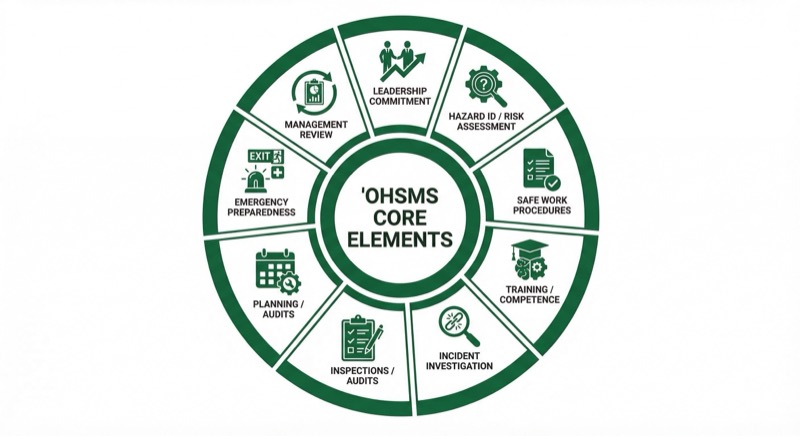
Most contractors think an OHSMS is just a bigger safety manual. They are wrong. A safety manual is one piece. An OHSMS has interconnected elements that create a closed loop, often built around the Plan-Do-Check-Act (PDCA) cycle.
Here are the core elements recognized by CCOHS, WorkSafeBC, and ISO 45001:
- Leadership commitment and policy: Senior management sets the direction, allocates resources, and is visibly accountable. This is not a signed policy page. It is active involvement in safety decisions.
- Hazard identification and risk assessment: Systematic processes for identifying hazards and controlling risks before someone gets hurt. This includes your field-level hazard assessments (FLHAs), job hazard analyses, and site inspections.
- Safe work procedures and training: Written procedures for how work gets done safely, plus training to make sure every worker on your crew understands them. Not a one-time orientation. Ongoing, documented competency checks. Safety Evolution offers online training courses with instant certificates and expiry tracking to keep your crew current.
- Incident investigation and corrective actions: When something goes wrong (or almost goes wrong), you investigate the root cause and fix it. This is where most small contractors fall short: they fill out the form but never close the loop. If you need a solid process, grab Safety Evolution's free Incident Report and Investigation Kit.
- Inspections and monitoring: Regular workplace inspections, equipment checks, and performance monitoring that catch problems before they become incidents.
- Emergency preparedness: Documented plans for fires, chemical spills, medical emergencies, and evacuations. Practiced, not just filed.
- Worker participation: Workers have a voice in identifying hazards and improving safety. Joint health and safety committees where legally required, but real participation beyond the minimum everywhere.
- Management review and continuous improvement: Regular reviews of the entire system to identify what is working, what is failing, and what needs to change. This is the "Act" in Plan-Do-Check-Act.
Here is the blunt truth: most contractors have pieces of this in place. The problem is those pieces are not connected. Your toolbox talks do not feed into your hazard tracking. Your incident investigations do not trigger updates to your safe work procedures. Your management never reviews the data. That is not an OHSMS. That is a collection of paperwork.
How Does an OHSMS Connect to COR Certification?
This is the question that matters most if you are a contractor trying to win work. COR (Certificate of Recognition) certification is the third-party verification that your OHSMS meets provincial standards. You cannot get COR without an OHSMS. The OHSMS is the foundation; COR is the stamp that proves it works.
In Alberta, the process works like this: you build your OHSMS, register with a Certifying Partner like ACSA (Alberta Construction Safety Association), get your system audited by a certified auditor, and if you score at least 80% overall with a minimum of 50% on each element, you earn your COR. That COR then qualifies you for WCB premium refunds through the Partnerships in Injury Reduction (PIR) program: 10% of your industry rate in the first year, and up to 20% as you maintain it.
In BC, the COR program is administered through WorkSafeBC with the BCCSA (BC Construction Safety Alliance) as the certifying partner for construction. COR-certified employers in good standing receive a 10% annual financial incentive on their WorkSafeBC premiums.
The connection is direct. No OHSMS, no COR. No COR, no WCB discounts. And increasingly, no COR means no bid. If you want a deeper look at the COR certification process, we have a full guide to COR certification in Alberta.
Do Small Contractors Actually Need an OHSMS?
Here is where most small contractor owners check out. "I have 8 guys. I do not need a management system." Understandable. But wrong.
Canadian health and safety legislation requires most employers to have a health and safety program. An OHSMS helps you meet that requirement in a way that is organized, auditable, and scalable. And if you want COR or SECOR certification, you need one, period.
SECOR (Small Employer Certificate of Recognition) exists specifically for businesses with 10 or fewer employees in Alberta. It is a streamlined version of the COR process: you conduct a self-assessment of your OHSMS, your Certifying Partner reviews it, and you earn your certification. If you are a 6-person electrical sub in Edmonton who just lost a bid because the GC required COR, SECOR is your path. We wrote a complete guide to SECOR certification that breaks down every step.
The scale of your OHSMS should match the scale of your operation. A 10-person framing crew does not need the same documentation as a 200-person industrial contractor. But both need the same core elements: leadership commitment, hazard identification, safe work procedures, incident investigation, and continuous improvement. The depth changes. The structure does not.
And here is the part nobody tells you: building an OHSMS when you are small is dramatically easier than trying to retrofit one when you hit 30 employees and a GC hands you a 50-page safety prequalification package. Start the system now, and it grows with you.
What Is the Difference Between an OHSMS, a Safety Program, and ISO 45001?
These terms get mixed up constantly. Here is the breakdown:
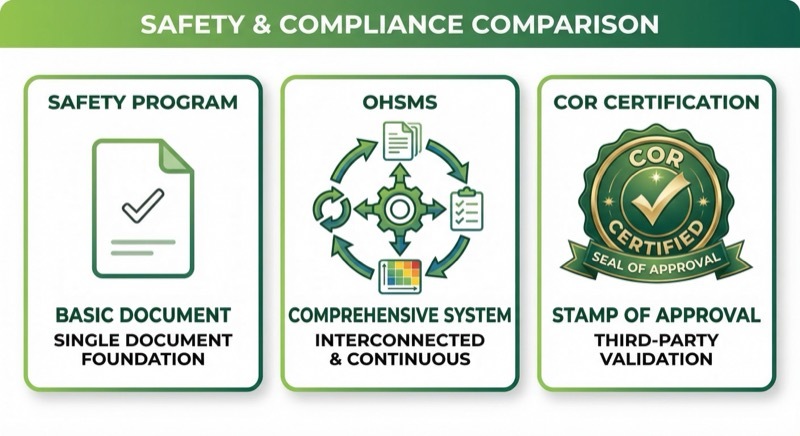
A safety program (or health and safety program) is the set of policies, procedures, and activities that an employer uses to protect workers. Every province requires one in some form. It is one component of an OHSMS.
An OHSMS is the broader management system that contains your safety program plus the organizational processes for planning, implementing, monitoring, reviewing, and improving it. It turns your safety program from a static document into a dynamic, self-correcting system.
ISO 45001 is the international standard for occupational health and safety management systems, published in 2018. CSA Z45001:19 is the Canadian adaptation with additional requirements specific to Canadian workplaces. These are frameworks you can certify against, much like COR, but with international recognition.
COR is Canada's industry-specific OHSMS certification. It is recognized across provinces and, in many cases, is the standard GCs and project owners require. COR 2020 (used in Ontario) aligns closely with ISO 45001/CSA Z45001:19.
For most Canadian contractors, COR is the practical choice. It is what GCs ask for, what WCB incentive programs recognize, and what certifying partners like ACSA and BCCSA are set up to support. ISO 45001 makes more sense if you operate internationally or need certification recognized outside Canada.
How Do You Actually Build an OHSMS?
This is where the rubber meets the road. And honestly, this is where most contractors get stuck.
You start with a gap analysis: what do you already have, and what is missing? Most contractors are surprised to find they have more pieces in place than they think, but those pieces are scattered across filing cabinets, Google Drives, and the foreman's truck.
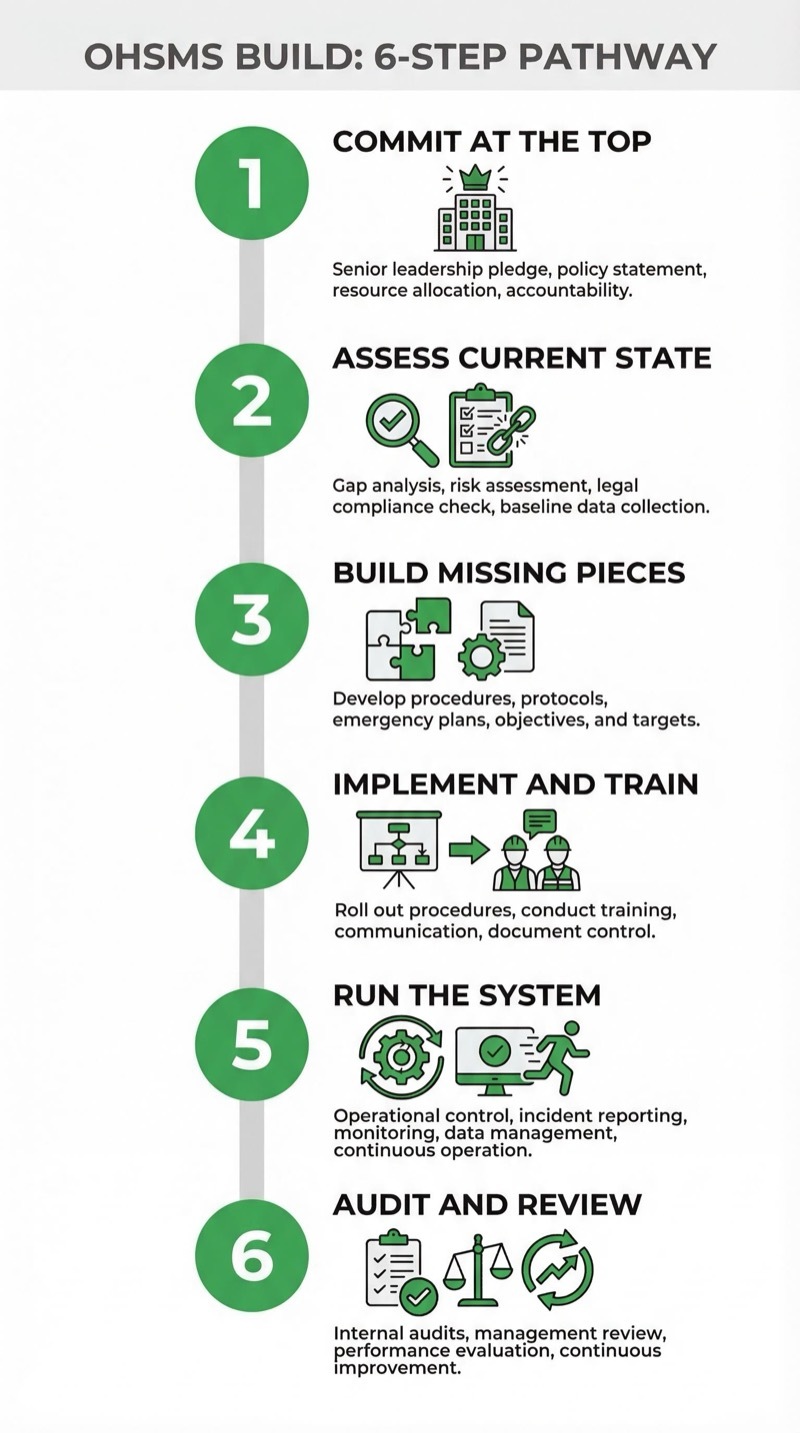
The typical path looks like this:
- Commit at the top. The owner or GM signs the safety policy and actually means it. Allocate time, budget, and a person responsible for driving the system forward.
- Assess your current state. Map your existing policies, procedures, and records against the OHSMS elements your Certifying Partner requires. Identify the gaps honestly.
- Build the missing pieces. Write the procedures you do not have. Create the forms you need. Set up hazard reporting, incident investigation, inspection schedules, and training records. If you are starting from scratch, Safety Evolution's free Orientation and Onboarding Package can help you build one critical piece right away.
- Implement and train. Roll it out to your crew. Train every worker, supervisor, and manager on their responsibilities within the system. This is not a lunch-and-learn. This is documented, competency-verified training.
- Run the system. Conduct your toolbox talks, FLHAs, inspections, and incident investigations according to the procedures. Keep records. If you need weekly toolbox talk topics, we have a free package with 365 topics ready to use.
- Audit and review. After running the system for a few months, do an internal audit. Find what is not working. Fix it. Then, when you are ready, bring in the external auditor for COR certification.
How long does this take? It depends on where you are starting. If you have a decent safety program already, getting to COR-ready can take 6 to 12 months. If you are starting from zero, plan for 12 to 18 months. ACSA recommends 12 months of documented implementation before your certification audit.
The honest part: most contractors do not have the time to do this themselves. You are running crews, managing projects, and chasing bids. Building a complete OHSMS from scratch while doing all that is brutal.
That is exactly what Safety Evolution does. We build audit-ready safety management systems for contractors. We create the documentation, set up the digital forms, manage the ongoing compliance, and package everything so it is ready for GC submittals and audits. If you want to see what that looks like, book a free safety assessment. Thirty minutes, no obligation. You walk away with a clear picture of where you stand and a 90-day plan to get where you need to be.
We also have a detailed step-by-step post on implementing a health and safety management system if you want the full implementation playbook.
Want Expert Eyes on Your Safety Program?
Book a free 30-minute assessment with a safety consultant. You’ll get a 90-day action plan, whether you work with us or not.
Get Your Free Assessment →Frequently Asked Questions About OHSMS
Is an OHSMS legally required in Canada?
Canadian health and safety legislation requires most employers to have a health and safety program. A certified OHSMS is not legally mandatory in most jurisdictions, but it helps employers meet their legal obligations and is required for COR/SECOR certification. In some jurisdictions, like the City of Toronto, an OHSMS certificate is mandatory for construction contracts.
What is the difference between an OHSMS and COR?
An OHSMS is the management system itself: the policies, procedures, and processes you use to manage workplace safety. COR (Certificate of Recognition) is the certification you earn when a third-party auditor verifies that your OHSMS meets provincial standards. Think of the OHSMS as the engine and COR as the certification that proves the engine runs properly.
How much does it cost to build an OHSMS?
Costs vary widely depending on company size, industry, and existing safety program maturity. Estimated costs range from $3,000 to $15,000 or more for small to mid-size contractors, including documentation development, training, and audit fees. Working with a provider like Safety Evolution can reduce costs by providing structured templates, digital tools, and expert guidance.
Can a small contractor with 5 employees have an OHSMS?
Yes. The scope and complexity of an OHSMS should match your operation. A 5-person crew needs the same core elements (leadership commitment, hazard identification, safe work procedures, incident investigation, continuous improvement) but at a scale appropriate to the business. SECOR certification in Alberta is designed specifically for employers with 10 or fewer employees.
What WCB premium discounts can I get with an OHSMS and COR?
In Alberta, COR-certified employers can receive WCB premium refunds of up to 20% through the Partnerships in Injury Reduction (PIR) program: 10% in the first year, with ongoing discounts as you maintain certification. In BC, COR-certified employers receive a 10% annual financial incentive on their WorkSafeBC premiums. Exact amounts vary by province and claims history.
The Bottom Line on OHSMS
An OHSMS is not extra paperwork. It is the system that makes all your existing safety work count. It connects your toolbox talks, FLHAs, incident reports, and training records into a single, auditable framework that proves your company manages safety for real.
If you need COR or SECOR to bid on work, you need an OHSMS. If you want WCB premium discounts, you need an OHSMS. If you are growing past 10 employees and feeling the compliance pressure, you need an OHSMS. And if you want to build it right the first time instead of scrambling before an audit, you need a partner who does this every day.
Safety Evolution builds audit-ready OHSMS programs for contractors across Canada. We handle the documentation, digital forms, daily compliance verification, and GC submittal packages so you can focus on running your crew.
Book your free safety assessment and get a 30-minute call plus a 90-day action plan. No obligation, no sales pitch. Just a clear picture of where you stand and what it takes to get COR-ready.